Multi-cloud Architecture x SABSA

What does a well-architected solution look like?
This is a question that often plagues me from time to time. There are hundreds of ways to skin this cat (sorry to my feline friends).
If we take a SABSA approach, the answer could be “a solution that meets all the needs of the business and effectively manages positive and negative risk(s)”.
That’s one approach, but regardless of your frame, the requirements (business needs) will continually change over time as technology creates new opportunities, new threats emerge, and society advances.
So a well-architected solution has to be something that changes too. This is where modularity, flexibility and scalability come into the picture.
A well-architected solution must be flexible and scalable, among other things, to remain well-architected over time.
The best reference for well-architected cloud solutions today is the well-architected framework. It comes in three different but very similar flavours: Microsoft (Azure), Amazon (AWS) and Google (GCP).
All three providers share five of the same attributes, commonly called ‘pillars’. They are:
Operational Excellence
Security
Resiliency
Performance Efficiency
Cost Optimisation
Sustainability (AWS only)
Only AWS provides a sixth pillar: sustainability. I like the sustainability attribute because, in the broadest sense, sustainability refers to the ability to continuously maintain or support a process over time.
This doesn’t mean Microsoft and Google have lost the game, but it does mean that how you maintain and support your architecture on these platforms over time is entirely up to you—as it should be. Some guidance in such an important area would be nice, though.
So, going back to my original question, what does a well-architected solution look like?
Now, this is where SABSA enters the chat.
I came up with an idea to create a business attribute profile (BAP), but instead of putting on my CEO hat and deciding what attributes I wanted for my business, I used the six well-architected pillars.
I was thinking if I could complete an attribute profile from the contextual business layer down to the service management layer, then I would have answered my plaguing question, and I would have a well-architected cloud solution regardless of which vendor you choose.
Here’s how it turned out.
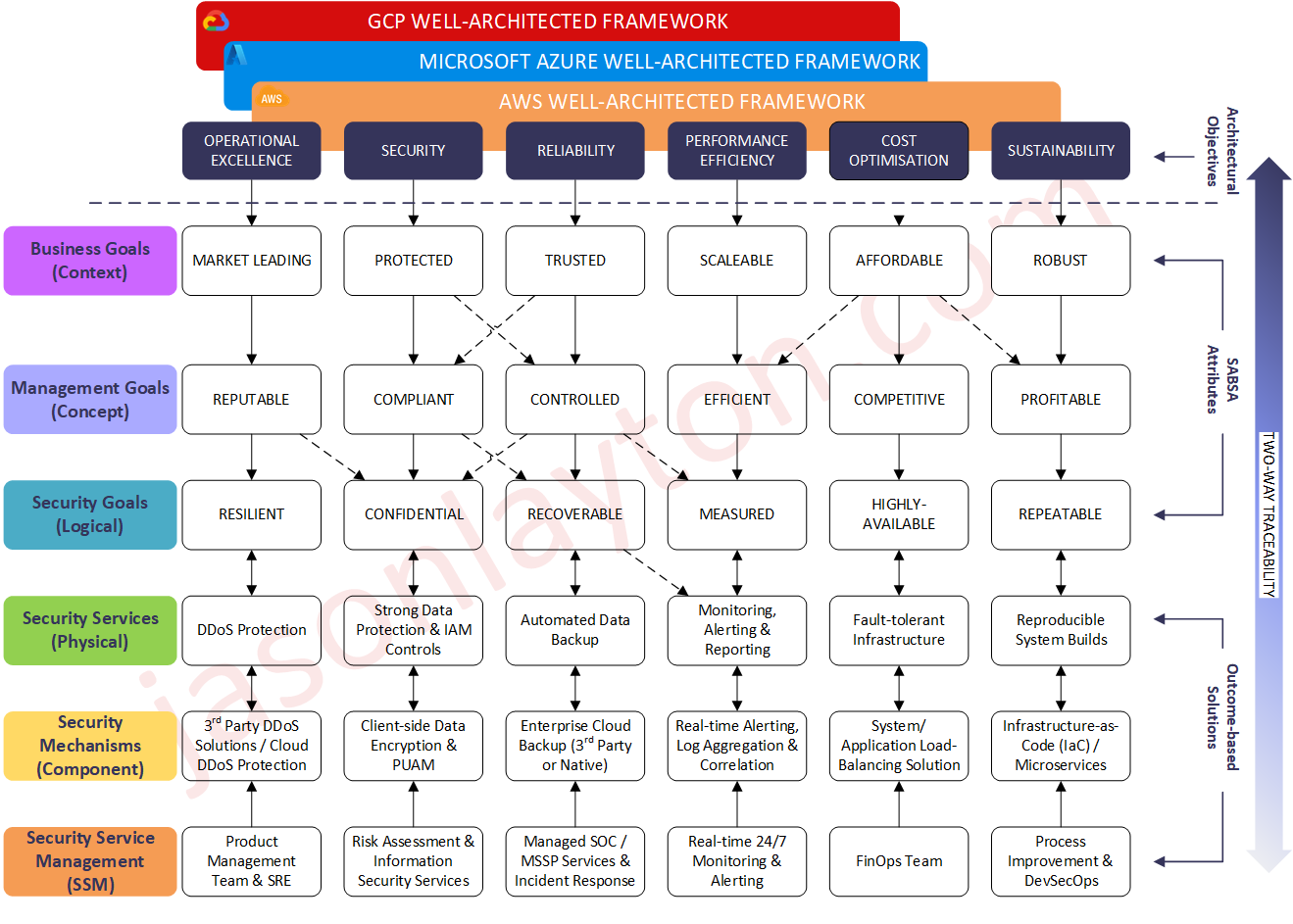
SABSA business attributes profile using multi-cloud well-architected attributes
I chose to remain vendor agnostic at the physical and component layers, but you can easily import your preferred vendor solution/product to meet your specific design goal.
Overall, this was a fun activity. The modular nature of the SABSA layers makes it fairly easy to maintain, update and support your architecture as business requirements and technology change over time.
The service management layer brings everything back to the beginning. Directly supporting our business objectives for a well-architected cloud-agnostic solution.
